
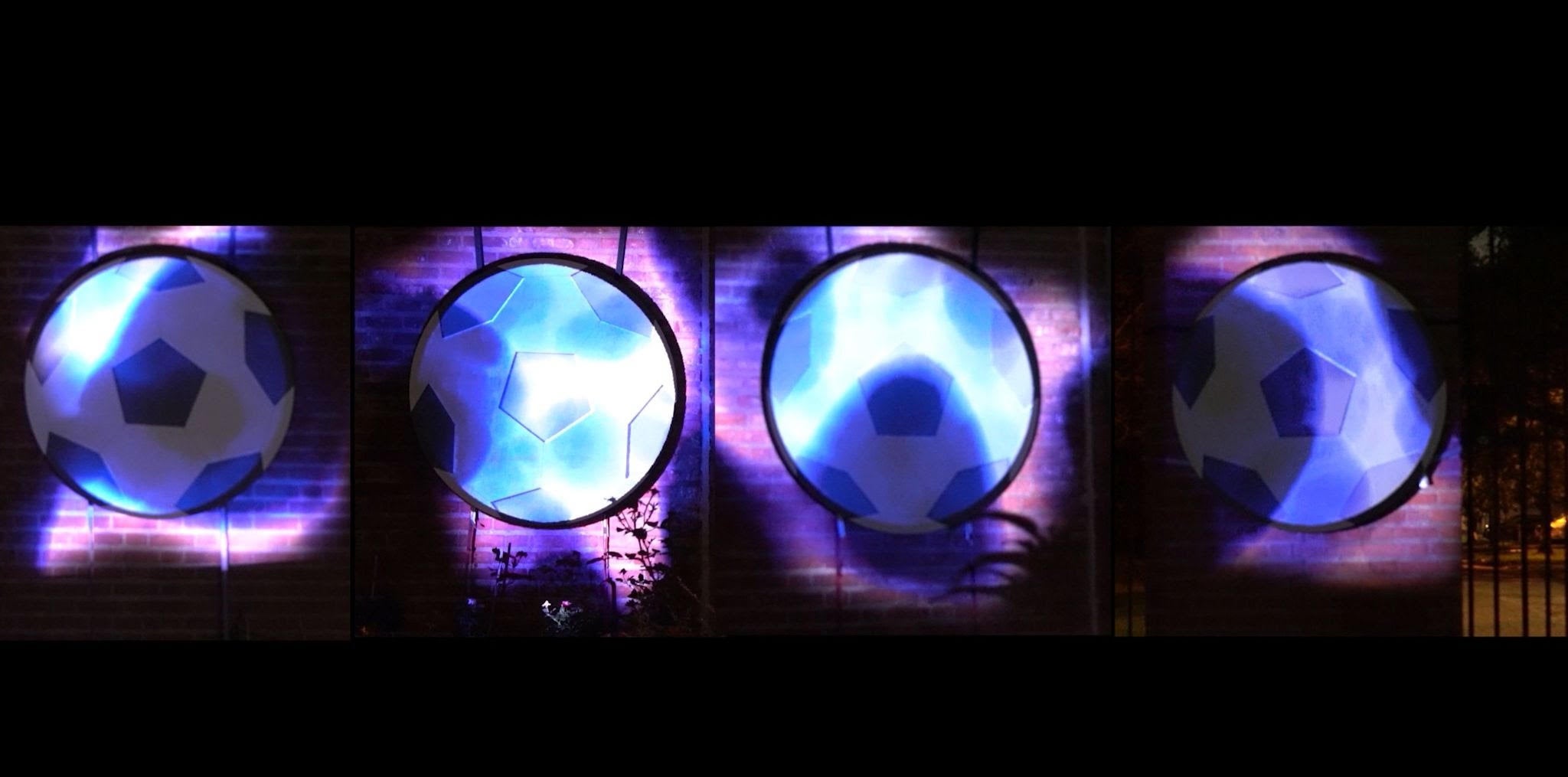
For visitors passing through Rice University’s main entrance this summer, a series of oversized soccer balls became more than a nod to the 2026 FIFA World Cup. After dark, the structures transformed into digital canvases displaying student-created artwork through light, motion and color.
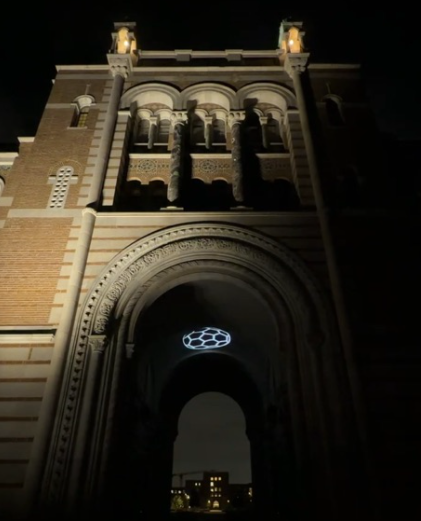
Across campus, another experience unfolded beneath the iconic Lovett Hall Sallyport, where synchronized lights, stadium sounds and a moving soccer-ball spotlight turned the historic archway into an immersive audiovisual experience.
Behind both installations was a complex engineering challenge — and an opportunity for Rice students to apply technologies studied in the lab to highly visible, real-world environments.
Developed by Rice’s Experiential Pixels (EXP) Lab in the Department of Electrical and Computer Engineering, the installations combined spatial computing, projection mapping, distributed computing, networking and digital media to transform student artwork into experiences at an architectural scale.
The installations were part of Rice’s broader Sustainable Ecologies initiative, organized by David Abraham, lecturer in biosciences. Abraham led a portfolio of projects that used Houston’s role as a World Cup host city as a living laboratory for sustainability, resilience, public engagement and applied research, bringing together collaborators from across Rice.
For the EXP Lab team, the initiative also created an opportunity to put its research into practice — and to give students experience designing technology for a public audience.
Engineering behind the experience
Led by Robert LiKamWa, associate professor of electrical and computer engineering, the EXP Lab develops hardware and software systems for spatial computing and extended reality. Working alongside LiKamWa on the project was Qianyu Ma, project manager for the EXP Lab, who helped organize and coordinate the installations, bringing together the technical, creative and logistical elements needed to transform the projects from concepts into public-facing experiences.
At Rice’s main entrance, four soccer-ball-shaped structures served as canvases for artwork created by Rice students around themes of sustainability, ecology and the World Cup. Rather than treating each structure as an independent display, the team designed animations to move continuously across the entrance as one visual experience.
Before the artwork reached the physical structures, students could preview their designs using a digital tool created with 3D Gaussian Splat rendering. The technology allowed artists to visualize how two-dimensional designs would translate onto the circular soccer-ball surfaces.
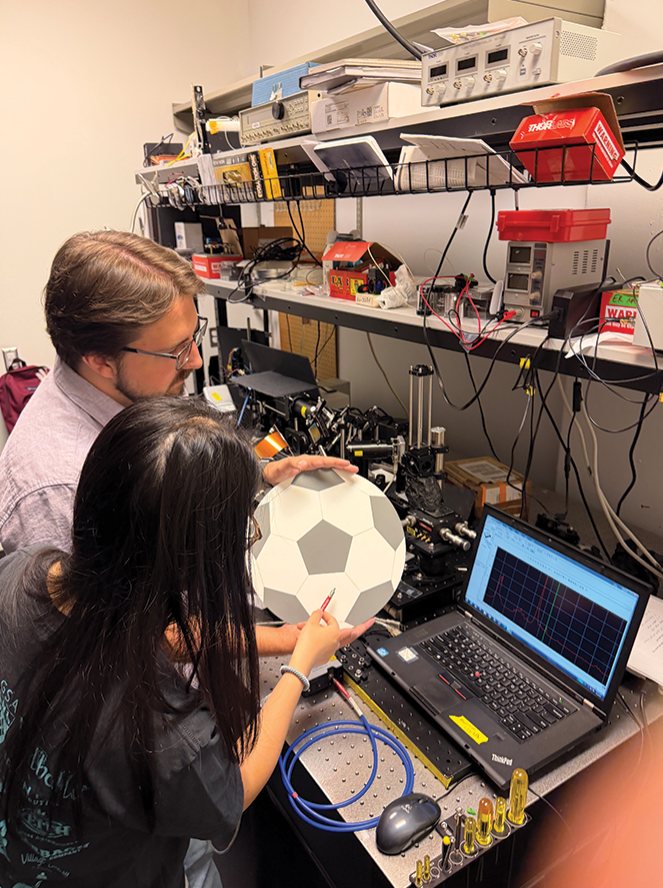
EXP Lab students also conducted material spectroscopy and color calibration to understand how the canvases responded to projected light, helping ensure that the colors visitors saw more closely reflected the artists’ original designs.
Turning the Sallyport into a digital testbed
At Lovett Hall, the engineering challenge was different.
The team first 3D-scanned the Sallyport and reconstructed the site virtually, allowing students to develop and test spotlight sequences before deploying them on the physical building.
Once programmed, animation data was processed and sent to Raspberry Pi controllers connected to lighting fixtures throughout the space. A custom network synchronized the controllers with audio, allowing lights and sound to operate as a coordinated system.
For Lauren Gold, a postdoctoral researcher who worked on the Sallyport installation, the historic architecture wasn't simply a backdrop for the technology. It became an integral part of the experience.
“For us, sustainable ecologies meant designing with the architecture — we wanted to transform how people saw what was already there,” Gold said. “The Sallyport became both the setting and the structure of the installation. We illuminated the archway from within, allowing the light to remain contained inside the building and making the windows glow.”
Those windows became goalposts as an animated soccer ball traveled across the walls and ceiling. The team carefully mapped the ball’s movement to the Sallyport’s distinctive architecture.
“We took special care to map the ball’s movement to the curvature of the arch, allowing the animation to activate the full breadth of the historic space,” Gold said.
Combined with crowd noise and stadium sounds, the resulting sequence evoked the progression of a soccer match, transforming the familiar campus landmark through light, movement and sound.
For visitors, the experience lasted only minutes; however, making those minutes appear seamless required students to solve problems involving networking, hardware, software, physical installation and synchronization.
Learning beyond the lab
The project brought together EXP Lab students with responsibilities ranging from network configuration and lighting design to physical installation, material spectroscopy, color calibration and 3D reconstruction.
For students, deploying the installations also meant confronting challenges that differed from those they might encounter in a controlled classroom or lab environment. The technology needed to function reliably for a public audience — including when no one from the team was there to operate it.
Fife Akinyanmi, an EXP Lab student who worked on the project, drew on previous experience using technical elements in theater productions but found that building an installation designed to operate independently required a different approach.
“I’ve worked with technical elements for artistic applications before in theater productions, but this was a bit different — I wasn’t going to be there every night to make sure everything turned on, and I was building software from the ground up to do what we would need for our project,” Akinyanmi said. “I’m really glad that I had constant feedback from my PI and advisor. They helped me make sure I had something I could let run on its own.”
That experience reflected one of the project’s broader lessons: engineering for a public installation required students to think beyond whether a system simply worked and consider how it could operate reliably outside the lab.
Students from outside engineering also played a central role. Rice artists submitted original work for the entrance installation, bringing perspectives from disciplines across campus. Engineering provided the infrastructure that allowed those ideas to move beyond a screen and into the physical environment.
For the student artists, the process also offered a chance to see their work translated into an entirely different medium and scale.
Ling DeBellis, one of the student artists whose work was featured in the installation, explored subjective experience and the emotions that come from connecting with nature. Seeing her video artwork projected onto the installation added another dimension to that idea.
“I found it very cool to have the projections blend into Rice’s own campus ecology, and for passersby on Main Street to catch snippets of the projections as they walked or drove by,” DeBellis said. “I hope that experiencing the installation and the artwork in our day-to-day lives is at least enriching, but ideally, maybe it makes us find a new perspective or thought.”
A campuswide effort
Taking the installations from concept to reality required more than developing the underlying technology. Because the project was deployed across existing campus spaces and remained outdoors throughout the Houston summer, the EXP Lab team also had to account for weather, materials, structural considerations and university facilities requirements.
“It was a really interesting project to work on because so much of it went beyond the technology itself,” said Qianyu Ma, project manager for the EXP Lab. “One of our biggest challenges was figuring out how to safely operate and protect the equipment outdoors throughout a Houston summer, while dealing with the heat, humidity, rain, and the constraints of installing within Rice’s existing architecture.”
Those challenges made collaboration across the university an important part of the engineering process. The project received support from Fernando Cruz, engineering design supervisor at the Oshman Engineering Design Kitchen; Carlos Garcia, studio manager and chief preparator in the School of Humanities and Arts; Kyle Henricks, instructional lab manager; Robert Legans-Johnson, engineering design technician at the OEDK; Brent Moon, director of campus grounds and landscape design; George Ristow, assistant vice president of planning and design; and Austin Shelton.
For Ma, working with those collaborators demonstrated the importance of knowing when to seek expertise beyond the project team.
“As a project manager, I couldn’t be an expert in every material, structure, or facility requirement, so finding the right people and learning from their expertise was incredibly important,” Ma said. “Our collaborators helped us understand everything from canvas materials and structural design to what was possible within the university’s architectural and facilities requirements. A lot of people shared their knowledge, helped us work through problems, and ultimately made the installation possible.”
From research to public experience
Although the World Cup provided the occasion for the installations, the technology behind them connects directly to questions the EXP Lab continues to explore.
The lab’s research sits at the intersection of systems engineering, creative media and human-computer interaction, including the development of visual computing systems and creative production pipelines for immersive experiences.
The installations demonstrated what those ideas can look like outside a traditional laboratory. Virtual reconstruction became a tool for programming a physical building. Distributed computing coordinated an audiovisual experience. Rendering technology helped artists preview their work before installation. Calibration techniques connected digital color with physical materials.
Together, the technologies created something visitors experienced primarily as art.
For Robert LiKamWa, associate professor of electrical and computer engineering and director of the EXP Lab, the project offered students an opportunity to put technical skills into practice while collaborating with artists from across Rice.
“On one hand, this was a great opportunity for engineering students to exercise electrical engineering and computer systems skills and problem-solving competencies, from spatial sensing to networking to projection technologies,” LiKamWa said. “On the other, we connected student artists across campus as they turned the campus into their hybrid physical-virtual canvas that deeply considered Houston’s role as a FIFA World Cup host.”
The World Cup brought a global audience and a unique creative challenge to Houston and Rice. For the students who built the installations, however, the lasting impact extends beyond the event itself.
Their work demonstrated how electrical and computer engineering can operate behind the scenes of an experience — connecting computation with architecture, art and the physical world — while giving students the opportunity to take technology from research and experimentation to something the Rice community could see, hear and experience.